

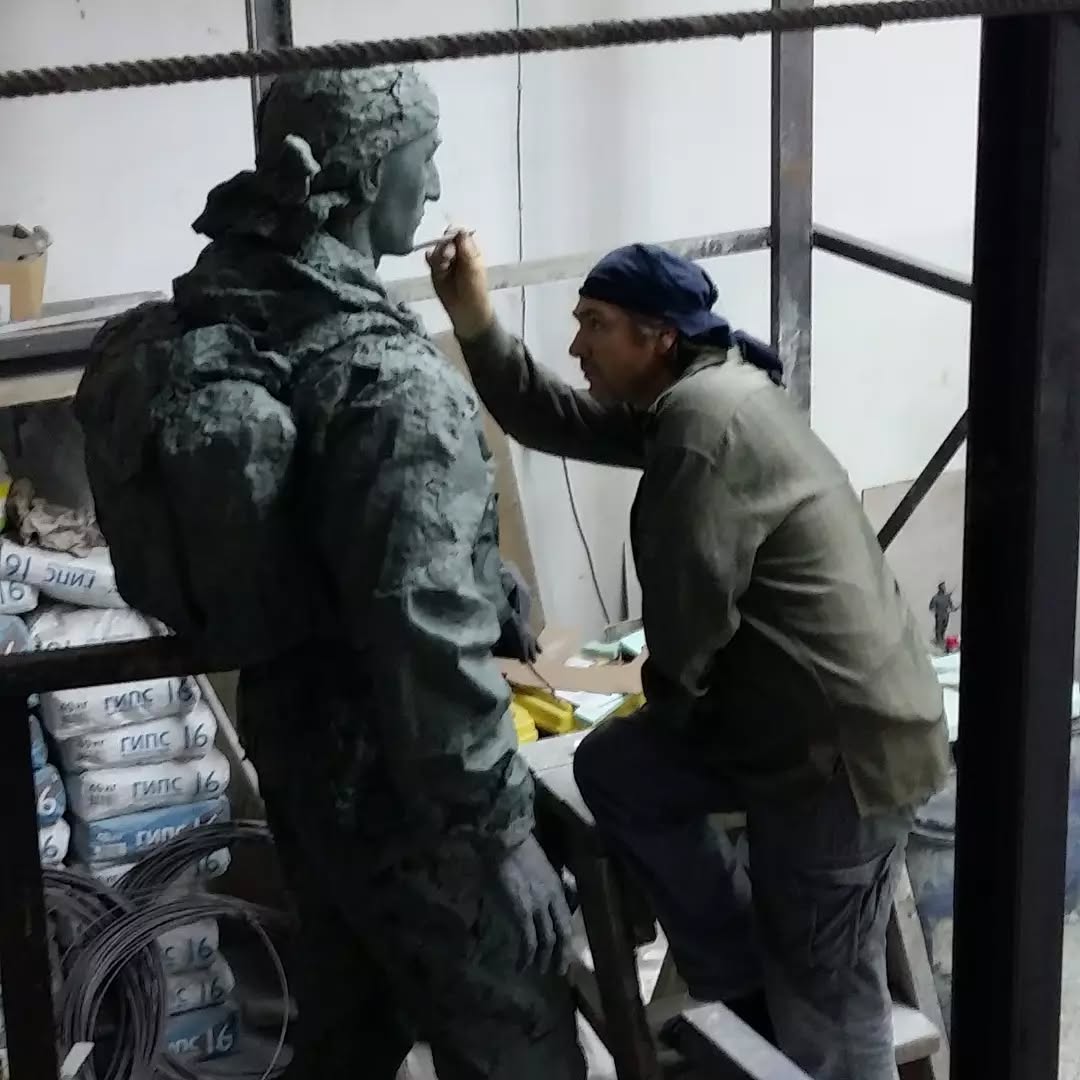
Creating a sculpture is a path where thought gradually takes shape, breath, and weight.
Each stage is a living process that combines intuition, craft, and philosophy.
Structure is born out of the chaos of an idea, plastic out of a line, and presence out of metal.
Below I share the stages that each of my work goes through.
Over time, each of them will be detailed in a separate article.
1. The idea
It all starts with an internal impulse — a thought, a feeling, an image.
Sometimes it's a flash, sometimes it's a long maturation.
The main thing is to capture the essence, what should be expressed not in words, but in form.
2. Drawing
At this stage, a line appears — the first fixation of the idea.
Drawing helps to build proportions, understand movement, and capture the mood.
It's like a map where the path is already visible, but the texture of the road has not yet been determined.
3. Modeling from plasticine of several variants
I am sculpting several versions of the future shape, experimenting with rhythm, mass and composition.
These searches allow you to see how different the same image sounds.
Plasticine gives freedom, and the hand becomes an extension of thought.
4. Choosing an option
When the options are ready, the moment of choice comes.
It's not just a decision about form, it's a choice of meaning, state, and energy that the work carries.
Sometimes it's obvious, sometimes it requires silence and time.
5. Editing the molding of the selected option
After the selection, refinement begins: the lines become cleaner, the mass becomes more collected.
The character of the sculpture, its breathing, and its emotional accent are born here.
This stage is like talking to an already living being — you listen to what it wants to say.
6. Molding
When the molding is completed, a mold is created for transfer to another material.
This is a delicate technical job where it is important not to lose a single millimeter of plastic and texture.
The sculpture seems to be passing through a boundary — from a fragile state to a stable one.
7. Conversion to wax
Wax allows you to refine the surface, add details that cannot be done in clay.
He is gentle, but demanding — he reacts to temperature, light, touch.
This is a transitional moment between conception and eternity.
8. Transfer to bronze
The most dramatic stage.
Fire, metal, time — everything combines to make an idea become a body.
Bronze is the final test: here you can see the result of every inaccuracy, every breath in the process.
9. Assembly
If the work consists of several parts, they are combined into a single structure.
Each joint is like a seam on a living body: it must be strong but invisible.
10. Finishing up
Polishing, patina, light, texture — everything that turns bronze into a living surface.
This is the moment when a sculpture begins to breathe, when looking at it becomes a dialogue.
11. Landing on the plinth
The final gesture is to connect the sculpture with its support.
The plinth is not just a stand, but a part of the composition, a point of balance between the earth and the idea.
Here the work becomes complete and ready to face the world.…


article
>>